
Posted February 2, 2026
Decades of research and collaboration behind Gothenburg's quantum cluster
Behind Chalmers' quantum test bed, which is run by Chalmers Next Labs, lies 25 years of research and development. We met Giovanna Sammarco Tancredi, deputy director at WACQT, to hear about the biggest challenges in quantum research, what her research group is currently working on, and how Sweden can strengthen its international position.
How did you first become involved in the project?
- Prior to joining Chalmers, I was a postdoc at the University of Oxford, in the group of Dr Peter Leek. We were one of the first groups to work on scalable quantum processors based on superconducting circuits. I became really interested in this topic, and when the national research programme WACQTs started at Chalmers, I brought my whole family to Gothenburg and started working in this ambitious project.
Towards more powerful and reliable quantum chips
The goal of Giovanna's research group is to build a quantum computer with 100 qubits. The step from 1–10 to over 100 qubits is one of the biggest technical challenges in quantum computing: the more qubits on a chip, the more difficult it becomes to keep them isolated, manage noise, perform accurate calibration, and control all connections and wiring.
These challenges are at the heart of the group's work, which aims to enable larger and more powerful quantum chips in a stable, reproducible, and practical way. The research encompasses investigation of new methods for performning two-qubit operations, fast measurement of it's quantum state, and improved of qubit design and fabrication. In parallel, the aim is to develop solutions for automated qubit calibration, where today's time-consuming manual settings can be replaced by the push of a button.
What is your research group working on right now?
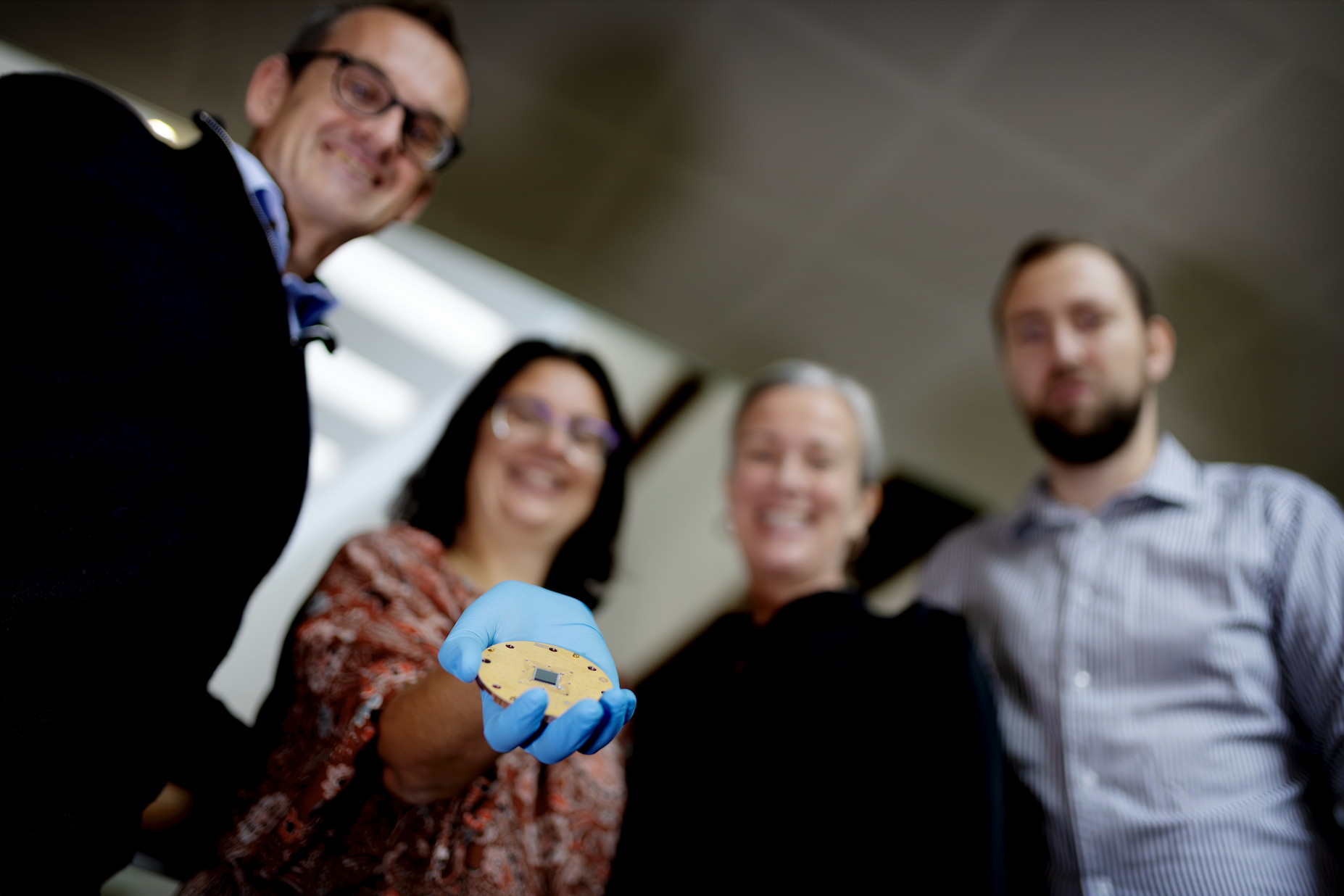
“Recently, the WACQT core project team has developed a 25-qubit quantum chip that is used in the test bed – an important step towards our goal of 100 qubits. The chip has been developed entirely at Chalmers, thanks to the unique technical infrastructure we have access to here,” says Giovanna.
How does Gothenburg's quantum cluster affect your research at Chalmers?
– Having companies close to us makes the research more concrete. The combination of cutting-edge expertise and our infrastructure really enables us to drive quantum computing forward – and it’s clear that interest in us has grown,” says Giovanna.
What more can Sweden do from your perspective?
– For Sweden to strengthen its position in quantum computing, we need to continue to improve the quality of the qubits themselves – their coherence time, performance, and gate fidelity. Here, Chalmers and Gothenburg can contribute with cutting-edge expertise and take a clear place in international development.
At the same time, we need to become even better at connecting academia, spin-offs, industry, and financiers. By sharing knowledge and resources, research results can be translated into new services and products much more quickly, says Giovanna.
She highlights the Netherlands as a good example, where Quantum Delta NL has built a national ecosystem that connects research, startups, industry, and policy for long-term social and economic benefit.
How do Sweden and Chalmers position themselves internationally in quantum research?
“We started later than many others, but we have built quality and depth in our research. The long-term, strategic investments made by the Knut and Alice Wallenberg Foundation and Chalmers have been absolutely crucial,” says Giovanna. Increased national investment would provide excellent opportunities to strengthen Sweden’s international position.
“Our team is small compared to global initiatives, but there is a tremendous amount of work behind the results. In relation to their size, the quantum researchers at Chalmers have achieved exponentially more,” she concludes.
Interested in how you can use the test bed? Contact me!
Sofie Skönvall
Administration
sofie.skonvall@chalmersnextlabs.se +46 (0) 704 30 16 36 Please contact me regarding the quantum test bed