
Posted October 23, 2026
Collaboration is needed to accelerate innovation
How do we translate technological breakthroughs into industrial applications and enhanced competitiveness? This was the topic of discussion among decision-makers and key figures from industry, technology companies, research, and the public sector at Ny Teknik’s “Industry of the Future” conference on October 21.
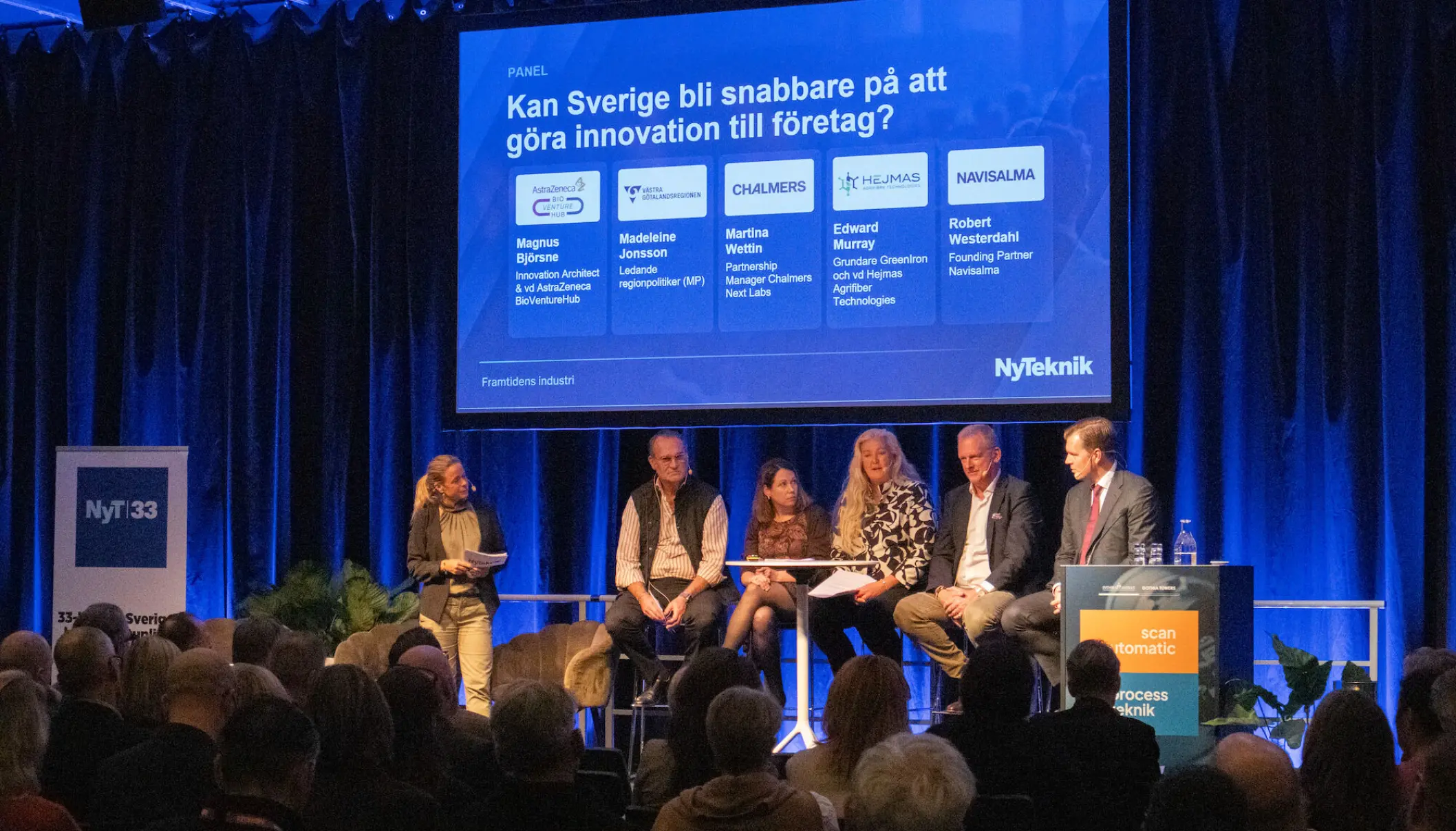
From New Ideas to Industrial Solutions
The conference discussed the choices that will shape Sweden’s industrial future. Sweden has a strong industrial tradition and is well-positioned to develop new technologies. But we live in an era of rapid technological advancement, global competition, and shifting geopolitical conditions.
It is not enough to be good at innovation. We also need to create the conditions for new ideas to be developed, tested, and scaled up into industrial solutions.
A shared direction requires a shared definition of the problem
Martina Wettin, Flagship Partnership Manager at Chalmers, represented Chalmers Next Labs in a panel discussion on how Sweden can strengthen its industrial competitiveness and accelerate the development of new solutions.
A key challenge is that stakeholders in research, entrepreneurship, and industry often operate under different conditions and time frames. For development to proceed more quickly, collaboration must therefore begin early on. The stakeholders need to agree on the problem to be solved or the change that needs to be achieved, and how quickly it needs to happen.
“There’s a sense of urgency. We understand that not everyone can do everything, but we really need to work together transparently and with a long-term perspective,” says Martina Wettin.
Establishing a shared direction isn’t about everyone working on the same things. It’s about clarifying needs, understanding each other’s circumstances, and building partnerships where different skills can complement one another.
From Technical Potential to Industrial Reality
Throughout the day, the discussion kept returning to a crucial question: Sweden has both technical expertise and entrepreneurs with ideas for the future—but how do we ensure that these innovations also lead to new products, businesses, and industrial capacity?
Developing new technology is just one step in the process. The next step may require long-term capital, access to test environments, industrial expertise, and customers who are willing to invest before a solution has been proven on a large scale.
Here, collaboration between research, startups, established industry, and public sector actors is particularly important. By working together to address real-world needs, these actors can create better conditions for testing new solutions, reducing uncertainty, and bringing the technology closer to practical application.
For Chalmers Next Labs, this is a central part of the challenge: to help ensure that the potential of new technology is translated into concrete development and benefits.
Collaboration for an Industry in Transition
"Industry of the Future" also raised issues regarding digital sovereignty, dependence on international technology suppliers, and access to energy. This demonstrates how the development of industry is influenced by factors that no single actor can address on its own.
This calls for cooperation across organizational and sectoral boundaries. It also requires a long-term perspective, in which investments in skills, technology, and infrastructure are aligned with the industry’s actual needs.
The discussions in Gothenburg highlighted both the challenges Sweden faces and the desire to find new ways forward. The next step is to turn these insights into action: to identify common problems, bring together the right expertise, and forge partnerships that can make a difference in practice.
For Chalmers Next Labs, the direction is clear
– The industry of the future requires a forward-looking and long-term approach, in which research, entrepreneurship, and industry work together toward common goals. By starting with real-world needs, we can transform ideas and new technologies into applications that benefit society.
Martina Wettin