
Posted September 29, 2026
Quantum technology won't wait—Sweden needs to get started now
Quantum technology was the focus when Chalmers Next Labs participated in the seminar “The Quantum Leap—How Sweden Is Taking the Lead in the Next Wave of Technology,” organized by IBM and AI Sweden during Almedalen Week.
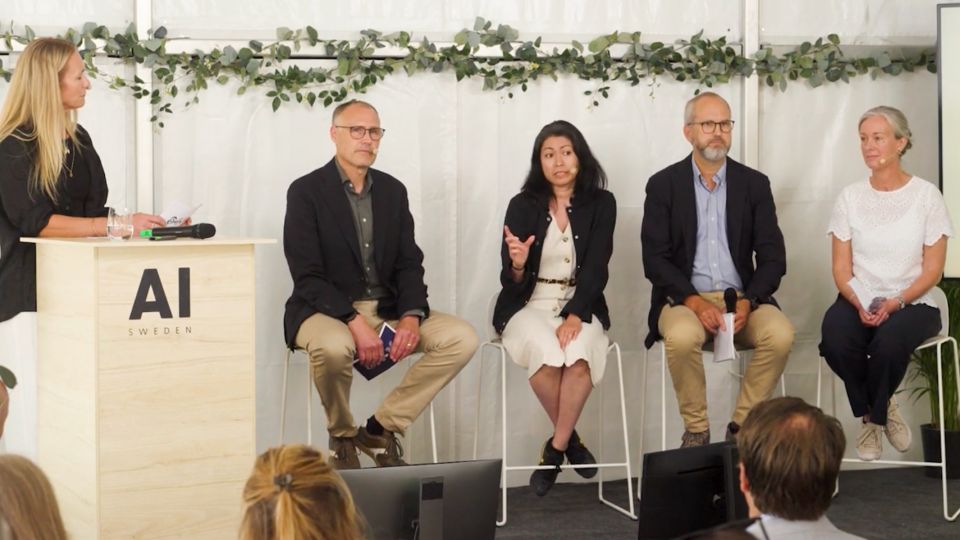
The panel discussion featured moderator Evelina Pärnerud (IBM), Fredrik Holmgren (IBM), Hanifeh Khayyeri (Qutwo), Emil Görnerup (Confederation of Swedish Enterprise), Monica Ringvik (Chalmers Next Labs), and Cecilia Edebo (Sahlgrenska Science Park—not pictured).
Quantum technology is rapidly moving from research toward practical industrial applications and could, in the long term, have a major impact in areas such as pharmaceuticals, materials, energy, transportation, and logistics.
However, the big question isn't just what technology will be capable of. It's also about how Sweden can create the conditions necessary for businesses and society to take advantage of these opportunities.
Get started now! Don't wait until the technology is ready.
One clear conclusion from the discussion is that companies should no longer wait for quantum technology to be fully developed and mature. Preparations need to begin now.
We do not yet know which areas of application will be the most important. Therefore, companies need to start familiarizing themselves with the technology, building expertise, and testing possible applications right now.
For those who wait until the technology is mature, there is a risk that they will have waited too long to build the knowledge required to actually use it.
For companies, therefore, it is not a matter of immediately investing in their own quantum computer. It may involve beginning to understand the technology, identifying complex problems within their own operations, and working with researchers and technology companies to explore where quantum technology can create value.
Kvant is a new tool and part of a broader technological development
Quantum technology will not replace AI or today’s computers. Instead, these technologies can complement each other. For example, AI can help us identify patterns, correlations, and possible solutions in large amounts of data.
In the long term, quantum computing can be used to solve certain types of complex computational problems in industry and to simulate materials, molecules, and other systems that are difficult to handle using current methods. It is this combination that is particularly interesting.
The computing environments of the future will likely incorporate several different types of technology, with each tool used for the problem it is best suited for. For industry, this means that quantum technology needs to be viewed as yet another part of the digital toolbox.
Sweden is in a good position, but that's not enough
Sweden has several of the components needed to establish a strong position in quantum technology:
“Sweden needs to move away from the current model of many small, separate collaborative projects that are supposed to be able to integrate with one another after the fact,” says Monica Ringvik, CEO of Chalmers Next Labs.
– When multiple technological shifts occur simultaneously, we need instead to create more cohesive pathways from research to the market.
“We need continuous collaboration and a steady flow, from research and innovation all the way to new companies, products, and services,” says Monica Ringvik.
However, for us to succeed, all these elements need to be better integrated. It is important to develop expertise and technology at the same time.
Collaboration Builds a Stronger Quantum Ecosystem
The ecosystem and collaboration play a crucial role. Researchers, companies, the public sector, investors, and entrepreneurs need to find more ways to work together. There are already national research centers, innovation hubs, companies, and startups.
There are also initiatives involving both collaborations and partnerships between universities, industrial companies, and research institutes.
One of Sweden’s most comprehensive research programs is the Wallenberg Center for Quantum Technology (WACQT) initiative.
The WACQT initiative is coordinated by Chalmers University of Technology, and funders such as the Knut and Alice Wallenberg Foundation have provided crucial funding. Chalmers Next Labs provides access to test beds and laboratories. The goal is to build an advanced Swedish quantum computer capable of solving problems that are beyond the reach of even the best existing supercomputers. The quantum computer is based on superconducting circuits, with a target of 100 fully functional qubits.
We also need to cooperate internationally.
Test earlier. Develop faster.
Business needs must be incorporated early in the research process, and research findings must be able to be translated more quickly into new products and services.
– “An important part of this is creating environments where companies can gain exposure to quantum technology and test it in practice at an early stage,” says Monica Ringvik.
The Importance of Testing and Research Environments
Today, we can speculate about which applications will become important. But as the technology develops and matures, entirely new possibilities may open up. That is why we need to create environments where companies have the opportunity to experiment, test, and build expertise together with researchers. By working on real-world problems, we can identify the areas where quantum technology can actually make a difference.
It is also important to build on the companies that are already emerging in the field of quantum technology in Sweden.
It’s not just about using off-the-shelf quantum computers. There are also opportunities to develop the technology itself, such as hardware, components, software, and algorithms. In the long run, these could become significant Swedish export successes.
Expertise and collaboration will be crucial
Quantum technology requires expertise in several fields, ranging from physics and mathematics to programming, engineering, and industrial applications.
Sweden does not have to do everything on its own. International cooperation is crucial, and we need to be an active and attractive part of the Nordic, European, and global efforts in quantum technology. This means we need to find more ways to collaborate across academia, industry, startups, investors, and the public sector.
We need to dare to invest, experiment, and have the courage to believe that quantum technology will play a significant role. This applies to both the business sector and the political sphere. Sweden needs long-term and sustained investments in quantum technology, research, expertise, and the infrastructure required to develop and utilize this technology.
Our Most Important Takeaway from Almedalen
Sweden is in an excellent position to take a strong stance in the next wave of technological innovation. But research and successful companies alone are not enough.
We need:
- bring research, industry, startups, capital, expertise, and infrastructure together more effectively
- create test environments where companies can learn about and experiment with quantum technology
- build expertise and identify areas of application even before the technology is fully mature
- provide Swedish quantum companies with better conditions to grow and develop competitive products and services
- collaborate at the Nordic, European, and global levels to take advantage of the expertise and infrastructure that already exist.
Perhaps the most important thing, then, is not to wait until the technology is ready, but to get started now.
We need courage, curiosity, and a long-term perspective. And we need to take this journey together.
Companies and organizations need to start learning about, testing, and exploring the potential applications of quantum technology and preparing their operations for a new type of computing power. By getting involved early on, we can build expertise, discover new opportunities, and prepare for a future where quantum technology becomes part of our digital toolkit.